https://drive.google.com/file/d/0B2o2iSYM_R11TjRlUEpsbVlFd0k/view?usp=sharing
Within this lesson you will find other links to Smartdraw.com which will allow you to create a technology based artifact. I have also embedded my own model for the Statehood Timeline:
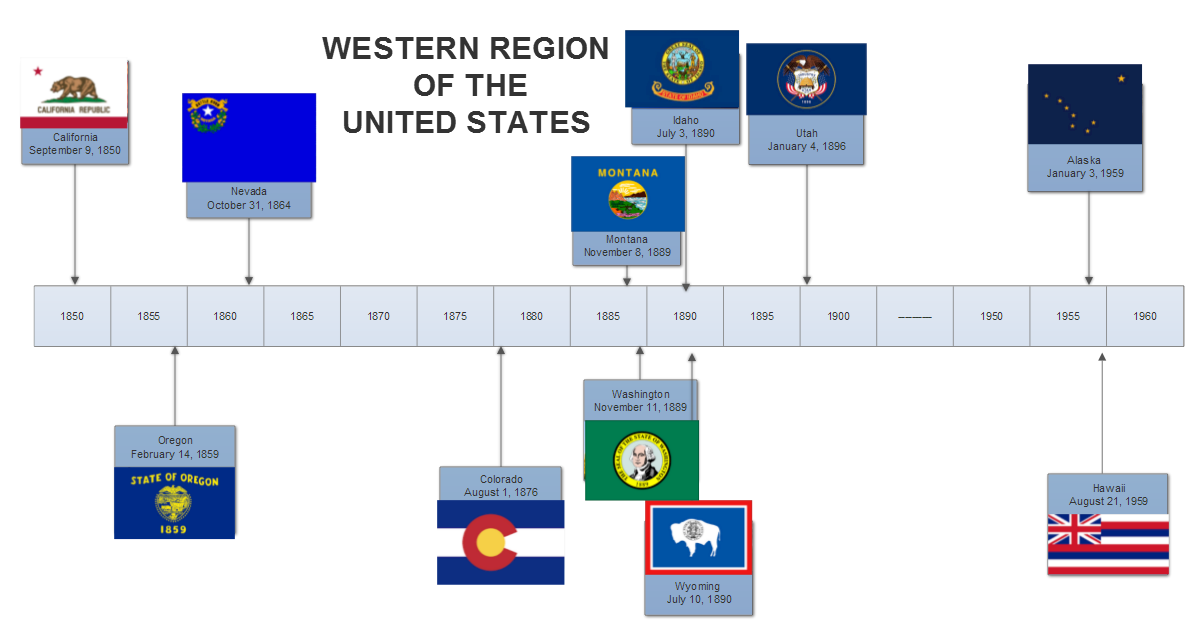
Here are some of the artifacts students in our class mad, this program allowed students to send me their timelines and I could "grade" them from SmartDraw directly.


Peer Reflection Survey
Please fill out the provided Peer Reflection Survey to help me improve my lesson plans and presentations. Thank you.
Lesson
Reflection: Phase 1
Reflection:
Assessing Prior Knowledge and Planning Instruction
Students
need to know prior to the lesson how to be able to research a given topic
online and through various websites to find the needed information for the
lesson. For example, students need to know how to look up on the internet what
the date of statehood was for a specific state. Student's prior knowledge
and experience will be assessed informally by the teacher as they circulate the
classroom during independent practice. If students do not have enough prior
knowledge, the teacher can pull a small group to work with on the
assignment. This knowledge and experience can also be assessed from
previous use of technology in the classroom. By knowing the skill levels of my
students, I will take into consideration students who might be on an IEP or ELL
students who may struggle with the technology aspect and incorporate small
group settings into my lesson plans.
It is important for this lesson to be taught at
grade level because the standards that this lesson is aligned with are at a 3rd
grade level. These students also need the content of this lesson to be at grade
level because the standards for the rest of the year will build upon the
content of that standard. The objective for this lesson is: “Students will be able to demonstrate their
understanding of time sequence by developing an electronic timeline of entry into statehood by region.” This objective directly links to the standard
which asks for students to be able to identify the sequence of historical data.
By creating a timeline students can see and show how the sequence of states
that entered statehood. This lesson will be taught in the beginning of the
year, the Arizona Social Studies Standards state that the third-grade standards
begin to introduce the effects of the exploration of North America to provide a
foundation for further study. This being done in the beginning of the year will
allow students to know the solid foundation of the development of our country.
Reflection:
Designing Instruction (In Task Standards 7 & 8)
The instructional methods I have described utilize
both individual work and group work to allow students to collaborate with one
another to allow peer to peer learning as well as learning from the teacher
during teacher modeling. By using differentiated learning strategies, it will
allow diverse learners to learn in many ways such as visually, kinesthetically,
and by speaking and listening. I want students to be able to learn through peer
discussions and researching content on their own but still with the assistance
of others since the students are in lower grades. This will allow students to
gain the knowledge for their future learning. Students will demonstrate creative
thinking by letting them develop and design their timelines however they wish
to design them. Students can import either the state flag or seal to make their
timelines creative, colorful, and their own.
Reflection:
Planning Assessment (In East Standard 6)
The assessment directly assesses a timeline that
will demonstrate the student’s knowledge of the time sequence of historical
data. Students will need to have their states placed in the correct order of
statehood which also aligns with their objective. Students will show on their
timelines if they have been successful in researching the dates of statehood
and correctly placed them in chronological order on their artifacts. Students
will demonstrate their engagement in higher order thinking by being able to
place the information they researched into a technology based artifact they can
display as part of their learning. This shows higher level thinking because
they are applying their knowledge of the content and not just simply regurgitating
information but rather placing that information in a technology based artifact.
This lesson demonstrates that individual needs were met by each student
creating their own artifact. Regardless of the student’s learning ability, they
were given the opportunity to create an artifact that shows their learning
needs were met. Also by implementing small group if necessary, students who
might have needed extra support as an individual could get that support.
Reflection:
How does your lesson meet each of the ISTE NETs Standards?
Students were encouraged to learn from their
research they took in the beginning steps of the lesson and were inspired to
create a timeline that expressed their own personal creativity. Students are required to utilize technology to create an
artifact through a digital-age learning tool which is Smart Draw. Students will
learn how to use this tool and implement and input the information they learned
from their research to create a technology based artifact. At the beginning of the school year students
will be taught and agree to a social contract that outlines the rules,
expectations, and guidelines of how technology is to be used and not abused in
the classroom. As a teacher, I will always demonstrate this throughout the year
and as well with this lesson. Students will be closely monitored while they are
online creating their timelines and will be reminded before the lesson of the
expectations of their behavior with using technology.
Mechanic
Lesson
Reflection: Phase II
Instructional Decisions/Teaching (InTask Standard # 9)
Implementing this lesson went very well and students seemed to be engaged
in not only using the program Smart Draw, but also with researching the states
for their timelines. Students could meet the objectives that were given at the
beginning of the lesson and produced a digital timeline that places historical
data into a time sequence. There were no modifications that were necessary
during the implementation of my lesson. Students were able to complete their
timelines and the states within the region they were given.
Mechanic
The technologies I, as the teacher,
used were computers, Smart Draw’s website, and You Tube. Utilizing the computer
and You Tube, I conducted the anticipatory set which was a video on states in
our country. I then modeled what website students needed to also go to and
modeled and directed them to the correct area of Smart Draw for them to begin
their timelines. Students used their computers and Smart Draw’s website to
create their timelines. Students also visited their preferred search engine to
conduct their research for the states in their regions. My lesson went a bit
over the given time frame, this is because students had a bit of difficulty in
navigating the Smart Draw website. Other than the difficulty at the beginning
of navigating the Smart Draw website, students were able to complete their
technology based artifact in a timely manner.
Assessment of Learning (InTask Standard # 6):
Students were successful in
mastering the objectives and meeting the standards in this lesson. Students, at
the end of the lesson, produce a technology based artifact that demonstrated of
time sequencing by developing an electronic timeline. Two digital artifacts students
created are displayed at the beginning of this blog post along with the model
I, as the teacher, created to show students the expectation of their artifacts.
Regarding teaching this lesson I feel successful in both implementing and using
technology to measure student learning. Both the reflection process as well as
the feedback given by my classmates has given me the ability to see what might
need improving if I use this lesson in my future classroom.
What did you learn from designing and teaching this lesson
and how will you use this in the creation of future lessons/learning
activities.
I learned from designing this and
teaching this lesson that choosing technology that will allow students to
create technology based artifacts is important because as technology is
integrated more into the classroom, students need to have the chance to utilize
these tools. This also allows students to develop some tangible item that shows
not only themselves, but their teachers and parents of their learning. I plan
on implementing more technology based learning in my future lessons since
students are so familiar with using the technologies at hand and the technologies
that are rapidly being produced. By using these technologies students will be
engaged and exciting about the learning of lessons and activities in the
classroom along with practicing using the different technologies that they will
be able to use in their futures

No comments:
Post a Comment